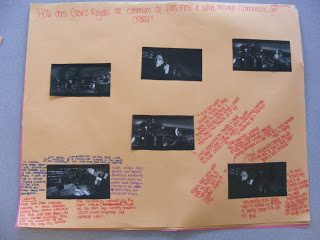
Below is the image of a research poster which we created, based on the opening of 'Casino Royal' and how it uses conventions of Film Noir. We commented on shot types, camera angles, costume, lighting, mise-en-scene etc.
Showing posts with label G321 thriller research. Show all posts
Saturday, 30 March 2013
Tuesday, 8 January 2013
Thursday, 20 December 2012
Tuesday, 18 December 2012
Monday, 26 November 2012
If thrillers were a tube map...
The point of the above 'Thriller tube map' is to display which common thriller themes or aspects occur in the certain films that we have observed in class. For example, one of the most common themes is violence since thrillers aim to carry out excitement, violence is almost always featured from very varied thriller films. If the line runs through the station of a film, it means that that film features that certain theme. From this tube map you can easily pick out the certain themes that always crop up.
Wednesday, 21 November 2012
LA Noire - How does it use features of film noir?
LA noire is a quite recent (2011) video game, it uses many conventions of the film noir genre since the enigmatic eeriness to those types of films works well when creating an interesting and exciting game to play. Firstly, the LA noire opening title is a typical glamorous lit-up sign however certain letters flicker which immediately implies a possible darker side of glamour, which is something that is typically covered in any films that fall under the genre of Film Noir.
The opening sequence then follows the title, it begins with a husky-voiced narrator describing the disruption within the city whilst classy cars drive past through a gleaming, built up city (with lots of those typical sky scrapers). Then the audience/game player is hit with the line of 'Where not everything is as it seems', a line which could not be more enigmatic - it automatically suggests corruption, possible crime, secrecy etc. all things which are totally entwined with film noir. The opening sequence continues to a clip of a couple kissing whilst expressionist jazz music is played over, helping to put across the glamour and class of the time and genre. One of the main things that LA noire seemed to steel from the film noir genre was the numerous lamp posts used throughout the opening sequence and within the actual game.
Lamp posts are constantly used in Film Noir due to the tiny focus of light on the floor that they produce, which creates the effect of a dimness outside that circle - creating a great deal of mystery and a feeling of tension/danger. Throughout the opening of LA Noire lamposts are featured on every street corner, and therefore the footage is dimly lit and dark. When deciding on the level that you participate on, you have a choice between homacides, thefts and other similar options. This menu is set out as a desk with case files on it, with the titles of the levels on them. The desk also has a gun, a cup of coffee, a cigarette and a magnifying glass. These props are all so commonly featured in the Film Noir genre because they all connote themes and moods of the genre, for example a gun connotes danger, risk, a close proxemity to death. Then the coffee and cigarettes imply luxury, self-indulgence and therefore possibly selfish actions yet glamour - all of which are linked in some way to Film Noir and therefore by featuring in LA Noire is relating to that genre.
When it comes to actually participating in the video game, the player is given the character of the detective and then given a partner to work with to solve a crime or a mystery together. The player is given a fast car, and the ability to take any other car from a civillian if they wanted/needed to. Here the player is given a powerful role and is very much in control of the narrative - the protaganist, and that's where the players focus is. Film Noir plots are usually very focused on the protaganist's journey, the mystery and tension is built up by them and their situations. Therefore having the player's focus on the detective/protaganist, the impression is given that the player is in a Film Noir.
One prop that specifically linked was the use of a torch throughout undergoing these challenges on the game, a prop very effectively used in 'The Third Man' in the sewer scene. It is an effective plot in a thriller since it means that only a small section of the surroundings are in view, therefore the remaining background is presented as even darker and more enigmatic. The audience's eye is drawn to the torches light and therefore waits in anticipiation for something that may shock them to come into view, effectively creating suspence. It is especially well used in 'The Third Man' due to the dark, undesirable, claustrophobic setting where the only light source seems to be the torch. The light from the torch in this scene then reflects off the sewer water creating an eerie moonlit impression and it creates further emphasis on the importance of this small piece of light in a very dark Film Noir. In LA Noire the torch prop is used in a similar way, the torch is always with the detective, bringing light to an enigmatic situation.
The similarities between Film Noir and LA Noire are very much highlighted in this advertisement poster, firstly the location is very typical. The tall sky scraper in the background which is an implication that the setting consists of a lot of action and many powerful people. Yet the dirty street where the character is placed is alike with the darker side of Film Noir, featuring the undesirable locations to match the often undesirable characters - as done above in 'The Third Man'. The characters costume is also very typical of the protagonist in Film Noir such as Jake in 'Chinatown' - the very smart suit and glamorous 1940's hat for example. The lighting not only creates a sense of moral ambiguity across his face using shadows, but across his entire body - showing that it wants the audience to pick up on it's strong links to Film Noir because that is what it aims to present itself as.
The opening sequence then follows the title, it begins with a husky-voiced narrator describing the disruption within the city whilst classy cars drive past through a gleaming, built up city (with lots of those typical sky scrapers). Then the audience/game player is hit with the line of 'Where not everything is as it seems', a line which could not be more enigmatic - it automatically suggests corruption, possible crime, secrecy etc. all things which are totally entwined with film noir. The opening sequence continues to a clip of a couple kissing whilst expressionist jazz music is played over, helping to put across the glamour and class of the time and genre. One of the main things that LA noire seemed to steel from the film noir genre was the numerous lamp posts used throughout the opening sequence and within the actual game.
Lamp posts are constantly used in Film Noir due to the tiny focus of light on the floor that they produce, which creates the effect of a dimness outside that circle - creating a great deal of mystery and a feeling of tension/danger. Throughout the opening of LA Noire lamposts are featured on every street corner, and therefore the footage is dimly lit and dark. When deciding on the level that you participate on, you have a choice between homacides, thefts and other similar options. This menu is set out as a desk with case files on it, with the titles of the levels on them. The desk also has a gun, a cup of coffee, a cigarette and a magnifying glass. These props are all so commonly featured in the Film Noir genre because they all connote themes and moods of the genre, for example a gun connotes danger, risk, a close proxemity to death. Then the coffee and cigarettes imply luxury, self-indulgence and therefore possibly selfish actions yet glamour - all of which are linked in some way to Film Noir and therefore by featuring in LA Noire is relating to that genre.
When it comes to actually participating in the video game, the player is given the character of the detective and then given a partner to work with to solve a crime or a mystery together. The player is given a fast car, and the ability to take any other car from a civillian if they wanted/needed to. Here the player is given a powerful role and is very much in control of the narrative - the protaganist, and that's where the players focus is. Film Noir plots are usually very focused on the protaganist's journey, the mystery and tension is built up by them and their situations. Therefore having the player's focus on the detective/protaganist, the impression is given that the player is in a Film Noir.
One prop that specifically linked was the use of a torch throughout undergoing these challenges on the game, a prop very effectively used in 'The Third Man' in the sewer scene. It is an effective plot in a thriller since it means that only a small section of the surroundings are in view, therefore the remaining background is presented as even darker and more enigmatic. The audience's eye is drawn to the torches light and therefore waits in anticipiation for something that may shock them to come into view, effectively creating suspence. It is especially well used in 'The Third Man' due to the dark, undesirable, claustrophobic setting where the only light source seems to be the torch. The light from the torch in this scene then reflects off the sewer water creating an eerie moonlit impression and it creates further emphasis on the importance of this small piece of light in a very dark Film Noir. In LA Noire the torch prop is used in a similar way, the torch is always with the detective, bringing light to an enigmatic situation.The similarities between Film Noir and LA Noire are very much highlighted in this advertisement poster, firstly the location is very typical. The tall sky scraper in the background which is an implication that the setting consists of a lot of action and many powerful people. Yet the dirty street where the character is placed is alike with the darker side of Film Noir, featuring the undesirable locations to match the often undesirable characters - as done above in 'The Third Man'. The characters costume is also very typical of the protagonist in Film Noir such as Jake in 'Chinatown' - the very smart suit and glamorous 1940's hat for example. The lighting not only creates a sense of moral ambiguity across his face using shadows, but across his entire body - showing that it wants the audience to pick up on it's strong links to Film Noir because that is what it aims to present itself as.
Monday, 12 November 2012
The Third Man - Sewer scene
The Third Man was created and produced in 1949 and it's a very good example of a dark film noir movie. The plot includes Holly Martins travelling over to a very dark, postwar Vienna, only to find himself investigating the mysterious death of an old friend, Harry Lime who was involved in some unethical black market trading.
In Film Noir, creating a certain atmosphere is extremely important - especially in scenes that are full of tension and drama. A very effective way of creating an uneasy, eerie atmosphere for the audience is by using claustrophobic techniques to keep the audience on edge. There's a very long scene in The Third Man which is set in a sewer and is the climax of the plot, Harry Lime has been seen and is being chased through the sewers by a huge number of policemen and soldiers. For example in this shot, the audience are given a claustrophobic impression due to the effect of the tunnel - because the only light is so far away the audience are put in what feels like a very dark place with very few escapes near. A tunnel also completely circles around the audience, the curved edges at the top of the tunnel give the feeling that the ceiling is pressuring down upon them.The outline of the character at the end of the tunnel also seems quite spooky due to the lack of visibility of his face or identity and therefore the audience actually want to back away in to the dark tunnel which again gives a claustrophobic feel. The stream of water running from the character to the camera, with the glimmer of light reflecting off of it, looks very similar to a lightening strike. Therefore the character is represented as dangerous, deadly perhaps, therefore the audience feel a fear towards this character.
Again, the screen shot (left) shows this. It also shows an even stronger "light at the end of the tunnel" a clear connotation to the close proximity to this character - Harry, and death. The panicked body language with the arms out to the side, facing the light also could symbolize Harry's shock towards this incident with death - a possible surprise ending. In both of the images, he is completely wearing black and pressed against a very bright white background which gives the impression that Harry is a dark, evil character who has been blocking any lightness/ happiness from the plot due to his actions. His body language in this frame is also very symbolic, the positioning of his arms resembles that of Jesus when he was crucified. Therefore there are definite links here between this and the character of Harry, due to the faking of his death and then appearing to "come back to life". However the slightly lower arms and the bent knees represent him as weaker than Jesus, due to his lack of morality and probably the fact that it wasn't a choice of his to be rediscovered.
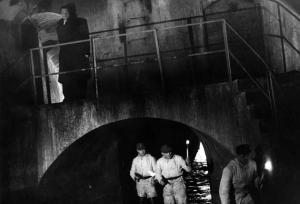
<Another example of a shot from the sewer scene is this, the very slight titled angle of the camera creates an uneasy and slightly disorientated feel to the shot. The audience are put in a position where they feel like the camera is edgy and possibly hidden, which works well to build tension in this scene. Harry on the ledge, higher than the police is a contradiction of what the audience may expect as in a way it represents him as a higher character. However the fact that he is hiding, pushed up against the wall implies that he should not be there - as despite a doctor being a highly valued profession, he did not deserve the title. The representation of good and evil is very obvious in this shot, the darkness and black clothing of harry and the balcony contrasts with the policemen in white with their torches (a light source). Therefore the audience is shown the classic good against evil. The shadows of the characters and the balcony is also typical film noir, the dark shadows add to the tension of the clip due to the dark patches and very little lighting.
Another shot from this scene is the below shot of the character Harry as the police and soldiers are searching for him and he's attempting to escape via a drain. The lighting upon his face suggests a character with a classic Film Noir moral ambiguity, as the upper half of his face is brightly lit whereas the bottom half is lit much darker therefore shows the contrast between the characters good and bad side. His slightly open mouth and squinted eyes add to the tension of the clip as the audience can clearly see his panic and worry due to his facial expression. The emphasis on his frown due to the lighting and the facial expression it's self represent him as a confused character, perhaps morally or perhaps in general. Again, the beads of sweet formed along his cheek and nose shows the audience that he's extremely scared or worried, he's possibly been doing a lot of running away. The fact that his eyes are looking up implies that throughout the film he had a goal or a target that he longed to reach and his actions were based on that target, as if possessed by a certain idea. It almost looks as if he's a moth drawn to a flame, his facial expression is almost dream like and possessed therefore there's a connotation that Harry as a character was drawn into something easily due to the positive aspects of it despite the danger. The close-up used in this shot helps create that claustrophobic feel, due to the fact that the audience can see very little other than this characters face therefore question what's going on outside of this frame, since they only see a very small proportion of the action.
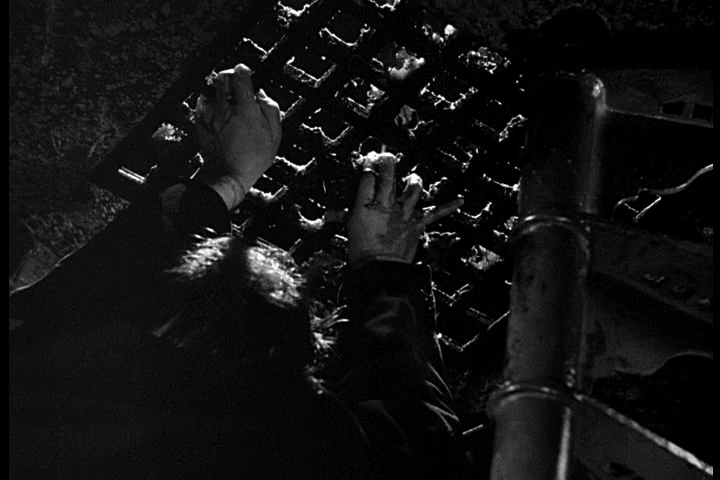
Below is the shot of Harry desperately trying to escape, trying to push the drain open after he had been shot. This is such a symbolic action, the way in which he is grabbing onto the bars suggests that he is trapped and desperately trying to escape this horrible situation that he has gotten himself into yet cannot. The light upon his head is obviously supposed to be moonlight, then the ruggedness of his hair and hands in a way represents him as a werewolf. A werewolf is dangerous and unruly though can be wrongly perceived in day time as a good human, very much like the character of Harry who was believed to be a good man previously when he was thought to be selling penicillin. The uneasy tilt on the camera here helps to once again, put the audience on edge since they're given the impression of very little stability and therefore that the audience are almost spying on Harry, given the feeling that they shouldn't be there. Finally the dirty hands of Harrys could easily represent his previous dirty deeds and how they have stained him as a person, which now he is trying to escape from yet cannot.
In Film Noir, creating a certain atmosphere is extremely important - especially in scenes that are full of tension and drama. A very effective way of creating an uneasy, eerie atmosphere for the audience is by using claustrophobic techniques to keep the audience on edge. There's a very long scene in The Third Man which is set in a sewer and is the climax of the plot, Harry Lime has been seen and is being chased through the sewers by a huge number of policemen and soldiers. For example in this shot, the audience are given a claustrophobic impression due to the effect of the tunnel - because the only light is so far away the audience are put in what feels like a very dark place with very few escapes near. A tunnel also completely circles around the audience, the curved edges at the top of the tunnel give the feeling that the ceiling is pressuring down upon them.The outline of the character at the end of the tunnel also seems quite spooky due to the lack of visibility of his face or identity and therefore the audience actually want to back away in to the dark tunnel which again gives a claustrophobic feel. The stream of water running from the character to the camera, with the glimmer of light reflecting off of it, looks very similar to a lightening strike. Therefore the character is represented as dangerous, deadly perhaps, therefore the audience feel a fear towards this character.
<Another example of a shot from the sewer scene is this, the very slight titled angle of the camera creates an uneasy and slightly disorientated feel to the shot. The audience are put in a position where they feel like the camera is edgy and possibly hidden, which works well to build tension in this scene. Harry on the ledge, higher than the police is a contradiction of what the audience may expect as in a way it represents him as a higher character. However the fact that he is hiding, pushed up against the wall implies that he should not be there - as despite a doctor being a highly valued profession, he did not deserve the title. The representation of good and evil is very obvious in this shot, the darkness and black clothing of harry and the balcony contrasts with the policemen in white with their torches (a light source). Therefore the audience is shown the classic good against evil. The shadows of the characters and the balcony is also typical film noir, the dark shadows add to the tension of the clip due to the dark patches and very little lighting.
Another shot from this scene is the below shot of the character Harry as the police and soldiers are searching for him and he's attempting to escape via a drain. The lighting upon his face suggests a character with a classic Film Noir moral ambiguity, as the upper half of his face is brightly lit whereas the bottom half is lit much darker therefore shows the contrast between the characters good and bad side. His slightly open mouth and squinted eyes add to the tension of the clip as the audience can clearly see his panic and worry due to his facial expression. The emphasis on his frown due to the lighting and the facial expression it's self represent him as a confused character, perhaps morally or perhaps in general. Again, the beads of sweet formed along his cheek and nose shows the audience that he's extremely scared or worried, he's possibly been doing a lot of running away. The fact that his eyes are looking up implies that throughout the film he had a goal or a target that he longed to reach and his actions were based on that target, as if possessed by a certain idea. It almost looks as if he's a moth drawn to a flame, his facial expression is almost dream like and possessed therefore there's a connotation that Harry as a character was drawn into something easily due to the positive aspects of it despite the danger. The close-up used in this shot helps create that claustrophobic feel, due to the fact that the audience can see very little other than this characters face therefore question what's going on outside of this frame, since they only see a very small proportion of the action.Below is the shot of Harry desperately trying to escape, trying to push the drain open after he had been shot. This is such a symbolic action, the way in which he is grabbing onto the bars suggests that he is trapped and desperately trying to escape this horrible situation that he has gotten himself into yet cannot. The light upon his head is obviously supposed to be moonlight, then the ruggedness of his hair and hands in a way represents him as a werewolf. A werewolf is dangerous and unruly though can be wrongly perceived in day time as a good human, very much like the character of Harry who was believed to be a good man previously when he was thought to be selling penicillin. The uneasy tilt on the camera here helps to once again, put the audience on edge since they're given the impression of very little stability and therefore that the audience are almost spying on Harry, given the feeling that they shouldn't be there. Finally the dirty hands of Harrys could easily represent his previous dirty deeds and how they have stained him as a person, which now he is trying to escape from yet cannot.
Monday, 29 October 2012
Casino Royale
Despite not falling under the genre of 'Film Noir' the opening to the James Bond film Casino Royale could easily fool an audience into believing that it does, merely from the conventions and connotations that it creates from the opening sequence (which is completely different to the remainder of the film).
For example one of the first shots captured is this:
Facial expression - The characters drooped mouth, wide eyes and slightly raised eyebrows imply that at this point the character is stressed, possibly in a dangerous situation and automatically, because of this on-edge persona the audience identifies him as perhaps an untrustworthy character and a possible villain in the plot. Typically in Film Noir films, the villian is a key character and is therefore introduced to the audience very early on in the narrative - as is done here. Themes and connotations hinted by the facial expression - such as danger, a fast-moving plot and a serious villian are all typical aspects of the Film Noir genre.
The camera shot - The low angle puts the audience in a position where they are looking up at the character, therefore he is represented as powerful and possibly scary to the audience. This is also often used in Film Noir to ensure that the audience fear the villain, therefore making suspense and tension throughout the film easy to create. The very slight tilt on the angle also distorts the audience, again making them feel on-edge and therefore interested in the plot of the film wondering what will happen next. Distorting the audience slightly is a commonly used strategy of FN, as the films generally have quite complex, fast-paced plots and if the audience are very interested (and watching intently to see what happens next), then it ensures that the audience will be able to understand and enjoy the film overall.
Another example of how Casino Royal uses Film Noir convensions is shown in this image by:
Setting: Where this particular scene is set is obviously in a large business' sky scraper and Film Noir's typical characters are usually either very rich or are very money orrientated. The very posh interior of the building implies to the audience - who know very little about this character at the time - is probably a man very high up in a successful business and therefore is quite an impressive figure. Not only the building where the opening of Casino Royal is set is typical of Film Noir, but the night-time setting is also a commonly used convention. Since the genre usually involves a great deal of mystery, running away, tension, lust and suspense and a dark knight connotes all of that. The night also means that few people are around, therefore the audience gains the impression immediately that there's something secretive and odd about this character going to his work place in the middle of the night, when no one is around.
The audience is then introduced to their hero - James Bond. Lighting- most Film Noir hero's are in some way morally ambiguous, though the audience know nothing of James at this stage in the plot, simply the lighting on his face connotes that he may be the typical FN hero. The half of his face that is lit up to almost show up as white, suggests that as a character he is good, compassionate, it reassures the audience that this is their hero. On the other hand the half of his face that is not lit, which only blends into the darkness implies that despite being the hero that doesn't mean that his hands are always clean, like most FN hero's he has perhaps killed people, broken the law, committed adultery etc. and maybe sometimes he gets lost and commits darker actions at points in the film. Typically in Film Noir, lighting is also very harsh which then creates dark, defined shadows which help to add to the theme of mystery. In this shot, behind James are a great deal of shadows created by his body and his chair - these help to create a very dark enigmatic setting (one which would easily fit into a film that fell under the genre of Film Noir).
.jpg)
Props: Generally, FN films do not rely heavily on props at all however almost every film of the genre features atleast one gun. In this shot, the gun is very clearly shown to the audience - a suggestion that it's an important prop which will probably be used throughout the film, since the focus of this shot, is the gun. A gun connotes every aspect of a Film Noir movie - defence, danger, power, risking life etc. The gun being in the draw could represent a secretive plot, suspense rather than a lot of obvious action - which is the structure of FN. The otherwise emptiness of the draws implies that the business office is not used for a business purpose, which implies some sort of corruption and secrecy.
.jpg)
Finally, this snap shot also suggests that Casino Royal has conventions of the Film Noir genre - mainly by the body language. The gun is being almost directly pointed at the camera therefore the audience are put in a position where they would feel intimidated. Yet the relaxed positioning (sitting down into the chair, one arm down and other than the gun pointing little other body language) this suggests that the villain is powerful and doesn't need body language to reinforce his speech because he's already powerful enough. This links to Film Noir because the villian is typically very dangerous and dark, the relaxed facial expression also implies that he's very used to handling guns - and as I stated previously, guns are a very key prop in the FN genre. The tight grip on the gun is an implication of a tight grip on the world of crime and corruption, a world in which Film Noir movies are set in.
For example one of the first shots captured is this:Facial expression - The characters drooped mouth, wide eyes and slightly raised eyebrows imply that at this point the character is stressed, possibly in a dangerous situation and automatically, because of this on-edge persona the audience identifies him as perhaps an untrustworthy character and a possible villain in the plot. Typically in Film Noir films, the villian is a key character and is therefore introduced to the audience very early on in the narrative - as is done here. Themes and connotations hinted by the facial expression - such as danger, a fast-moving plot and a serious villian are all typical aspects of the Film Noir genre.
The camera shot - The low angle puts the audience in a position where they are looking up at the character, therefore he is represented as powerful and possibly scary to the audience. This is also often used in Film Noir to ensure that the audience fear the villain, therefore making suspense and tension throughout the film easy to create. The very slight tilt on the angle also distorts the audience, again making them feel on-edge and therefore interested in the plot of the film wondering what will happen next. Distorting the audience slightly is a commonly used strategy of FN, as the films generally have quite complex, fast-paced plots and if the audience are very interested (and watching intently to see what happens next), then it ensures that the audience will be able to understand and enjoy the film overall.
Another example of how Casino Royal uses Film Noir convensions is shown in this image by:
Setting: Where this particular scene is set is obviously in a large business' sky scraper and Film Noir's typical characters are usually either very rich or are very money orrientated. The very posh interior of the building implies to the audience - who know very little about this character at the time - is probably a man very high up in a successful business and therefore is quite an impressive figure. Not only the building where the opening of Casino Royal is set is typical of Film Noir, but the night-time setting is also a commonly used convention. Since the genre usually involves a great deal of mystery, running away, tension, lust and suspense and a dark knight connotes all of that. The night also means that few people are around, therefore the audience gains the impression immediately that there's something secretive and odd about this character going to his work place in the middle of the night, when no one is around.
The audience is then introduced to their hero - James Bond. Lighting- most Film Noir hero's are in some way morally ambiguous, though the audience know nothing of James at this stage in the plot, simply the lighting on his face connotes that he may be the typical FN hero. The half of his face that is lit up to almost show up as white, suggests that as a character he is good, compassionate, it reassures the audience that this is their hero. On the other hand the half of his face that is not lit, which only blends into the darkness implies that despite being the hero that doesn't mean that his hands are always clean, like most FN hero's he has perhaps killed people, broken the law, committed adultery etc. and maybe sometimes he gets lost and commits darker actions at points in the film. Typically in Film Noir, lighting is also very harsh which then creates dark, defined shadows which help to add to the theme of mystery. In this shot, behind James are a great deal of shadows created by his body and his chair - these help to create a very dark enigmatic setting (one which would easily fit into a film that fell under the genre of Film Noir).
.jpg)
Props: Generally, FN films do not rely heavily on props at all however almost every film of the genre features atleast one gun. In this shot, the gun is very clearly shown to the audience - a suggestion that it's an important prop which will probably be used throughout the film, since the focus of this shot, is the gun. A gun connotes every aspect of a Film Noir movie - defence, danger, power, risking life etc. The gun being in the draw could represent a secretive plot, suspense rather than a lot of obvious action - which is the structure of FN. The otherwise emptiness of the draws implies that the business office is not used for a business purpose, which implies some sort of corruption and secrecy.
.jpg)
Finally, this snap shot also suggests that Casino Royal has conventions of the Film Noir genre - mainly by the body language. The gun is being almost directly pointed at the camera therefore the audience are put in a position where they would feel intimidated. Yet the relaxed positioning (sitting down into the chair, one arm down and other than the gun pointing little other body language) this suggests that the villain is powerful and doesn't need body language to reinforce his speech because he's already powerful enough. This links to Film Noir because the villian is typically very dangerous and dark, the relaxed facial expression also implies that he's very used to handling guns - and as I stated previously, guns are a very key prop in the FN genre. The tight grip on the gun is an implication of a tight grip on the world of crime and corruption, a world in which Film Noir movies are set in.
Tuesday, 23 October 2012
Film Noir
'Film Noir' general research
Film noir is a film genre which often deals with corruption, violence, exploitation and treachery. The plots were written by "hard-boiled" writers in the early 1940's, and are visually associated with a subtle black-and-white visual style that sprouted from German expressionist films (which feature bold and very artistic ideas, which are usually more dramatic than realistic). The camera work is very important for these films, shots are usually taken from quite extreme angles, distorting the audience, they're also quite suspicious (matching the tone of the films) for example taken from behind a door or round a corner, as if the audience are spying on the characters.Themes and moods that typically occur:
- Darkness
- Betrayl
- Crime
- Lust
- Deceit
- Bleakness
- Suspicion
The general style of the genre is typical for films set/written in the fourties, the leading lady whether she's a damsel in distress or a femme fatale is usually very glamerous to match the classiness of the film as a whole.
Costume
Typical Film Noir costume centers around the classy fourties era, therefore characters tend to be dressed in glamerous clothing for example male tend to be wearing suits, hats, braces and well made shoes etc. (As shown in the image below) however since the lead character in a Film Noir is usually a detective of some time there are other additions to this, such as hats which add to the enigmatic elements to these films. The suits tend to be dark to add to the classic style of the characters, the very low key colouring helps them to blend into the shadows and dark settings.
Whereas women's costume is usually very important, glamorous dresses and expensive-looking jewelry tends to be warn to add to the theme of lust between the hero and the leading lady. The lighting usually supports the mysterious, enigmatic narrative - it's generally a very strong and harsh light which creates huge shadows. These huge shadows are very effective when tension needs to be built because they add darkness to the background, and put emphasis any action the character does.The mis-en-scene is of great importance to Film Noir films, therefore the settings tends to be very mysterious and claustrophobic such as small business offices or next to lamp posts in the night time. However props are hardly used at all, the three props which will definitely occur though, are hats such as in the Maltese Falcon: Here the characters are spies and have to create an enigmatic persona, therefore with a hat covering a portion of a characters face and therefore expressions, it creates a more mysterious character.
Another key prop in the Film Noir genre, are cigarettes - as most of the films were either made or set in the forties or fifties, at the time it was considered extremely glamorous and classy to smoke. Again, cigarettes are featured in the Maltese Falcon - often because the characters may be in a stressful situation and despite the cool front that they put on, smoking shows them to be secretly on-edge. The audience are then left to worry about the fate of their hero, which makes it easier for the film producers to create suspense.
Heroes in film Noir:
Film Noir hereos tend to have similar characteristics such as they often have a moral ambiguity and they often stand out in society, not complying to 'social normality'. The hero's often lack companionship towards co-workers or other men in the plot, yet have a sincere weakness of a strong lust for beautiful women. Despite all of this, the audience always feel either sympathetic or feel admiration towards the hero, because he is generally represented as being lead into a bad situation, which he then regrets and tries to put right. For example Breaking Point's hero was Harry Morgan - he was a war hero, who was a father and husband with little luck. He falls into debt and then ends up as an accomplice in a robbery (example of moral ambiguity). This is the trailer for Breaking Point:-
In the trailer Harry is represented as a typical Film Noir hero; it shows their to be lust and a possible affair in the film, despite participating in illegal activities it's shown that he may know that it's wrong and feel guilty about what he is doing especially by the line of 'I don't want you to know about this, no part of it'. The opening shot of the trailer, is Harry kissing his mistress passionately alongside the title 'holds this kind of a woman...he's close to danger!' therefore straight away the audience can distinguish their hero. He's represented as quite noble however, he has told his mistress that he is in love with his wife therefore the audience feel that he's been caught up in a bad situation however is not a bad character, and therefore roots for the hero to succeed in the plot despite this obvious moral ambiguity - like most Film Noir hero's.
Film Noir Photos
Thursday, 4 October 2012
Thursday, 13 September 2012
Subscribe to:
Posts (Atom)


.jpg)
.jpg)